
SAAW, an indigenously designed and developed 120 kg class smart weapon, has been developed by the Defence Research and Development Organisation.

India on Wednesday successfully test fired its indigenously developed surface-to-air 'Akash' missile of the Air Force version from the integrated test range at Chandipur near Balasore in Odisha, the fifth trial of the anti-aircraft system in the last fortnight.
Though the ITR authorities were not immediately available for comment, defence sources said the sophisticated missile could not take off during the planned trial from the launch complex-III of the test range due to some "technical snag."
In a leap forward to fortify its skies, India successfully test-fired its indigenously developed interceptor missile which destroyed a 'hostile' target ballistic missile, a modified Prithvi, at an altitude of 16 km over the Bay of Bengal.
India on Monday successfully test-fired its nuclear capable 'Prithvi-II' ballistic missile, with a range of 350 kms, as pa rt of user trial by the armed forces from Chandipur off Orissa coast.
India on Friday test-fired the Brahmos supersonic cruise missile with certain new systems from the Integrated Test Range at Chandipur off Odisha coast. The test comes two days after defence scientists conducted a similar trial from the same site. "The missile was test-fired from a ground mobile launcher from launch complex-3 of the ITR at about 10 am," a senior official said.
India on Thursday test-fired the indigenously developed nuclear-capable Prithvi-II ballistic missile from the Integrated Test Range at Chandipur in Orissa as part of the user trial by the Army. "The missile mounted on a mobile launcher was test-fired from the launch complex-3 in the ITR at around 0905 hours," defence officials said.With a maximum striking range of 350 km, the missile is capable of carrying a pay-load of 500-1000 kg warhead.

Preparation for the test firing of super-sonic cruise missile BrahMos, likely to be held on Sunday, reached its final stage on Saturday at the Integrated Test Range (ITR) at Chandipur near Orissa.
India on Thursday successfully test-fired the 290-km range BrahMos cruise missile from the Integrated Test Range at Chandipur off the Orissa coast. The supersonic cruise missile with precision strike capability was test-fired from a mobile launcher at 11 am from launch pad no 3 of the ITR, defence sources said. "The trial was successful," they said. The missile, which can fly at 2.8 times the speed of sound, is capable of carrying conventional warheads up to 300 kg.
India on Sunday test-fired the 290-km range BrahMos cruise missile from the Integrated Test Range at Chandipur off the Orissa coast. "It was a user's trial by the defence forces," said a Defence Research and Development Organisation official. "User's trial of BrahMos conducted by the Indian Army was successful," ITR Director S P Dash said after the missile blasted off from a mobile launcher at nearly 11.35 am from the launch complex-3 of the test range.
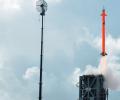
In a bid to galvanise its air defence capabilities, India on Tuesday successfully test fired a new, long range surface-to-air missile jointly developed with Israel from a defence base off Odisha coast.

The missile, which is about nine metres in length and one metre in width, can carry conventional as well as nuclear warheads and has a range of 350 kilometres.

This the second time that the missile has been test-fired in less than a month and is part of an effort to put in place a multi-layer missile defence system.

The missile positioned at launch pad-3 of the ITR swung in to action after getting signal from the radars to intercept a moving aerial target supported by an unmanned air vehicle (UAV) 'Banshee' over the Bay of Bengal, officials said.
The anti-aircraft missile, capable of ducking radar eyes and attacking enemy targets up to 110 km, was test fired from launch pad number 2 of the ITR complex at about 11.47 am, defence sources said. The test was conducted after an analysis of the data generated from yesterday's flight trial in order to further validate all major parameters, they said.
India's indigenously developed, beyond visual range air-to-air missile 'Astra' was successfully test-fired on Saturday from the integrated test range at Chandipur in Orissa.The single stage, solid fuelled 'Astra' missile "is more advanced in its category than the contemporary BVR missiles and it is capable of engaging and destroying highly manoeuvrable supersonic aerial targets," the source added.
The ground range instrumentation from ITR and the radar located near the impact point tracked the missile trajectory and monitored all the parameters from launch, the source said.
After a vertical lift-off at 12.15 pm from launch pad number three at the ITR, 15 km from Balasore, the surface-to-surface missile rose into the sky leaving behind a ribbon of white smoke, defence sources said.
It was the naval version of Prithvi, which has a range of 250 to 300 km.
Lakshya is the indigenously developed Pilotless Target Aircraft.
With a launch weight of 4.6 tonne which included payload of one tonne, Prithvi can use both solid as well as liquid propellant.
The supersonic cruise missile was fired from a mobile launcher at 12:10pm amidst heavy rains caused by a deep depression in the Bay of Bengal, which crossed the Orissa coast around the same time.
With a range of 25km, Akash is one of the five missiles currently under development by the Defence Research and Development Organisation.
The missile, which has a launch weight of 700 kg, can carry a warhead of 60 kg and operated in conjunction with a Rajendra surveillance and engagement radar being developed by the Electronic Research and Development Establishment.
The supersonic anti-ship cruise missile was jointly developed by India and Russia.

India has tested a 1,000 kg indigenously-developed glide bomb, which successfully hit a target 100 km away, in the Bay of Bengal off the Odisha coast, making the country self-reliant in guided precision bombs.
Akash was aimed at a target attached to Lakshya, the pilotless target aircraft.
The sophisticated multi-target missile was test fired from a mobile launcher at about 1230 IST.
Astra is an indigenously developed air-to-air missile.
DRDO scientists, who conducted the test, described it as a user's trial.
It hit a target dropped from an AN-32 aircraft.
After achieving the precision guidance capability from a fixed launcher in its fourth trial on October 29 last, the missile was on Sunday test-fired from a mobile launcher.
The sleek 3.8 metre high missile has a striking range of 25 to 40 km.
The DRDO has so far conducted 16 trials of the army version of the missile since its first trial on February 22, 1988.
This variant of the missile takes just 300 seconds to reach a target located at a distance of 150km.
 © 2026 Rediff.com - Advertise with us - Disclaimer - Privacy Policy - Sitemap - Feedback - About us - Terms of use - Grievances